
A vacancy rate rental assumption and a maintenance reserve rental line are the two operating buffers most optimistic underwrites leave off the sheet — or treat as a wish instead of a number. The rent still looks solid. The mortgage is fixed. Cash flow on the napkin says the deal works. Then vacancy and repairs get a real line, and the deal thins.
This post is a practical walk-through of one illustrative rental: optimistic cash flow with no vacancy and no maintenance reserve, versus the same stack with both buffers filled in. Not a real property, not investment, tax or legal advice. CapEx sinking funds (roofs, HVAC) are a different topic — covered in our Oct 8 piece — and stay off this sheet on purpose.
Vacancy rate rental: a percent of rent, not a hope
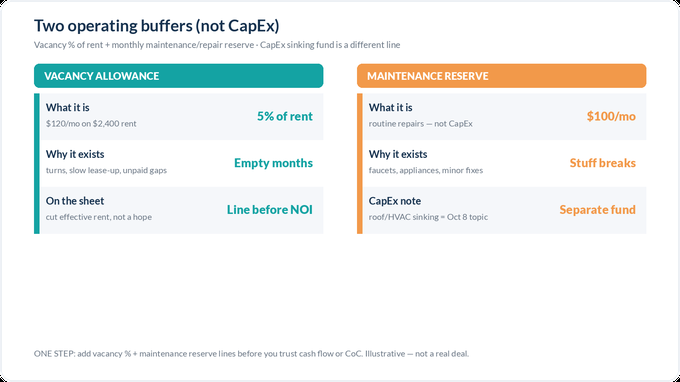
Vacancy is the empty-month problem: turns, slow lease-up, unpaid gaps between tenants. A simple underwriting habit is to treat vacancy as a percent of gross rent every month — even when the unit is currently occupied — so the model never assumes 100% collection forever.
On an illustrative $2,400/mo rent at 5%:
- Vacancy allowance = $2,400 × 0.05 = $120/mo
That $120 is not a prediction that this exact unit will be empty 18 days a year. It is an operating expense buffer so your cash-flow and cash-on-cash numbers do not pretend rent is fully collected every month.
Maintenance reserve rental: routine repairs, not CapEx
A maintenance reserve is a monthly set-aside for the stuff that breaks in the ordinary life of a rental — faucets, appliances, minor fixes, the calls that are not a new roof. It belongs on the operating side of the sheet.
CapEx is different. A CapEx sinking fund (cost ÷ remaining life → monthly transfer) is for big replacements. That habit still matters; it is just not today's math. Do not let a CapEx line substitute for a maintenance reserve, or the other way around.
On a sheet, that means three different habits:
- Vacancy: percent of rent (or expected empty months ÷ 12).
- Maintenance reserve: monthly dollars for routine repairs.
- CapEx sinking fund: big-ticket replacements on their own schedule.
Mixing them into one vague "reserves" blob hides which risk you actually modeled.
On this illustrative deal we use a flat $100/mo maintenance / repair reserve — separate from vacancy, separate from CapEx.
Optimistic cash flow vs cash flow with buffers
Keep rent, ops, and mortgage the same. Here is the illustrative stack:
- Rent (gross): $2,400/mo
- Operating (tax + insurance + management, illustrative bundle): $620/mo
- Mortgage P&I: $1,480/mo
Optimistic cash flow (no vacancy, no maintenance reserve):
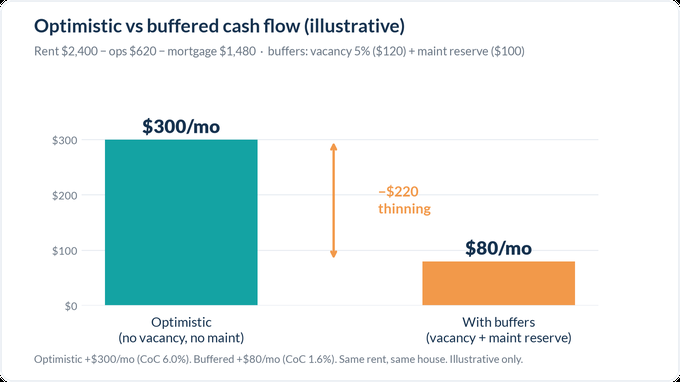
- $2,400 − $620 − $1,480 = +$300/mo
Add the two buffers:
- Vacancy allowance: $120/mo
- Maintenance reserve: $100/mo
Cash flow with buffers:
- $2,400 − $620 − $120 − $100 − $1,480 = +$80/mo
Thinning amount:
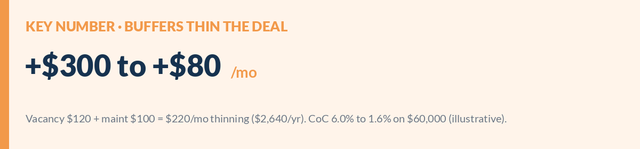
- $300 − $80 = $220/mo ($2,640/yr)
Ops and mortgage did not change. Only vacancy and maintenance got real lines. The deal that looked like a comfortable +$300 is now a thin +$80.
Where the $220 goes (and what stays the same)
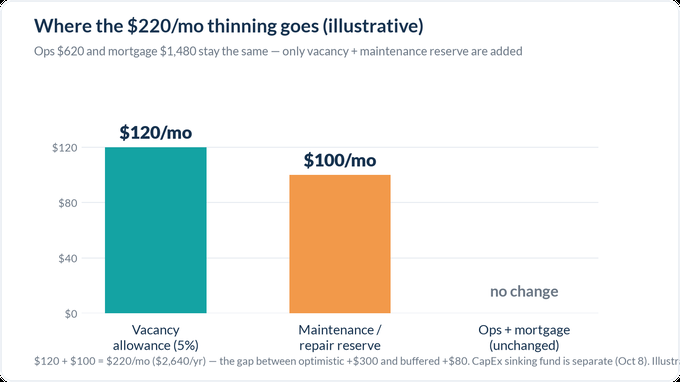
- Vacancy allowance: $120/mo
- Maintenance / repair reserve: $100/mo
- Ops $620 + mortgage $1,480: unchanged
That is the whole thinning story on this sheet: $120 + $100 = $220. If your underwriting reserves are higher (older property, slower market, heavier turns), the gap widens. If you leave both lines at zero, you are measuring a wish.
An operating expense buffer is not pessimism. It is underwriting that survives an empty month and a repair call without rewriting the story after closing. Thin-deal cash flow often starts as a blank vacancy cell and a blank maintenance cell — not as a bad property.
Underwriting reserves and thin-deal cash-on-cash
Cash invested (illustrative): $60,000.
- Optimistic CoC: ($300 × 12) / $60,000 = 6.0%
- Buffered CoC: ($80 × 12) / $60,000 = 1.6%
Same purchase. Same rent. Same mortgage. The only change is putting vacancy rate and maintenance reserve on the sheet before you trust cash flow or cash-on-cash. A 6% CoC that becomes 1.6% after operating buffers is a thin deal telling you the truth early.
ONE STEP THIS WEEK

Open the underwriting sheet for any rental you are considering (or already own). Add two lines before you trust the cash-flow or CoC number:
- A vacancy rate as a percent of gross rent (here, 5% → $120 on $2,400).
- A maintenance reserve as a monthly dollar amount (here, $100) — not CapEx.
Checklist:
- Write gross rent and the vacancy % you are willing to underwrite.
- Write a maintenance / repair reserve that is not the CapEx sinking fund.
- Recompute monthly cash flow with both lines in.
- Recompute CoC on the same cash invested.
- Ask whether the deal still works when vacancy and repairs are numbers, not blanks.
- Keep CapEx as its own sinking-fund habit (separate from today's buffers).
FROM ASSET AFC
If you want a real estate tool that already includes vacancy and repair reserves among its rental analysis outputs, try Cashflow Analyzer Pro from Asset AFC. Enter purchase price, rental income, expenses and financing terms; it helps you organize cash flow, NOI and related metrics so operating buffers are lines on the sheet — not wishes.
Illustrative numbers only. This isn't investment, tax or legal advice. Vacancy rates and maintenance needs vary by market, property age and management — use your own underwriting.
About Asset AFC: practical financial tools for real-estate investors and personal-finance organization — powerful underneath, simple on the surface.
Comments ()