
Every mortgage payment on a rental does two jobs. Part of it pays interest. The rest is principal paydown: it lowers the loan balance and adds to your equity. That second part is real return. It just doesn't show up in your bank account, and mixing the two is how a rental that barely cash flows gets described as "paying for itself."
Below is one illustrative rental and one loan, followed year by year: where the payment goes, how much paydown adds to ROI, who actually funds it, and how to track it. The property and numbers are made up, but they're realistic and they add up. This isn't investment, tax or legal advice.
The illustrative rental
- Property: a $300,000 rental, with $60,000 down (20%) and a $240,000 loan.
- Loan: 30-year fixed at an illustrative 6.5%, so the payment is $1,517 a month ($18,204 a year).
- Rent: $2,500 a month. Operating costs (tax, insurance, repairs): $800. Reserve set-aside for vacancy and big repairs: $150.
Cash flow: $2,500 − $800 − $150 − $1,517 = +$33 a month, or +$396 a year. On cash flow alone, this rental looks thin.
Where each payment goes: interest first, principal paydown second
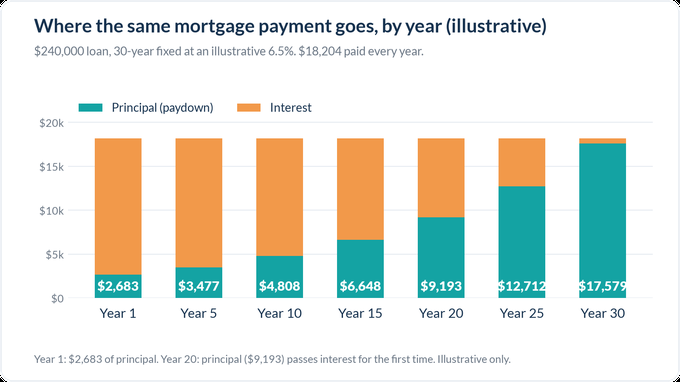
In year 1, the $18,204 of payments splits into $15,521 of interest and $2,683 of principal. Only 14.7% of what you pay that year reduces the loan.
The payment never changes, but the split does. Every month the balance is a little lower, so a little less goes to interest and a little more to principal:
- Year 5: $3,477 of principal.
- Year 10: $4,808.
- Year 20: $9,193 of principal against $9,011 of interest, the first year principal is the bigger share.
- Year 30: $17,579, or 96.6% of the year's payments.
Over the first five years, paydown adds up to $15,334, which takes the balance from $240,000 to $224,666.
Is principal paydown part of ROI?
Yes, as long as it gets its own line. On the $60,000 put in, year 1 looks like this (pre-tax, with appreciation left out on purpose):
- Cash flow: $396, or 0.7% of the cash put in.
- Principal paydown: $2,683, or 4.5%.
- Together: $3,079, or 5.1%.
Judged on cash flow alone, this rental returns 0.7%. Add paydown and it's 5.1%. Both numbers are true. They describe different things, and you need to know which one you're looking at. A full total-return view also gives appreciation and tax effects their own lines. They're left out here so the paydown is easy to see.
Where to find your own principal paydown numbers
You don't need to estimate this. Three places give you the real split:
- Your lender's year-end statement. Look for the interest paid for the year and the balance at year-end. Last year's closing balance minus this year's is the year's principal paydown.
- An amortization schedule. It shows the same split month by month, before it happens, so you can see next year's paydown today.
- Your own record of extra payments. Depending on your loan terms, extra payments can go straight to principal (check with your lender), and they change every line of the schedule after them. Track them on their own line so you can see what the extra money did.
Three things principal paydown is not
It isn't spendable. The bank account sees $396 this year, not $3,079. The other $2,683 is inside the property. If your plan depends on monthly income, cash flow is the number that pays the bills.
It isn't free when cash flow is negative. Drop the rent by $200, to $2,300, and cash flow becomes −$167 a month, or −$2,004 a year. The loan still drops by $2,683, but $2,004 of that came out of your own pocket. The property itself contributed $679.
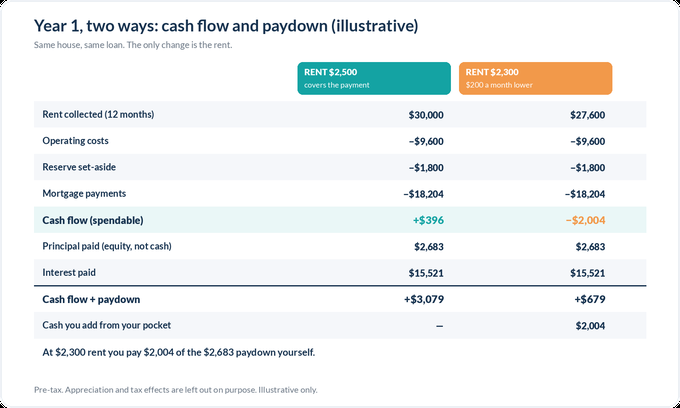
This is the quiet version of "the tenant pays down my mortgage." It's only true to the extent that the rent covers every cost and the whole payment. Below that, you're paying down your own loan, through the property.
It isn't reachable without a transaction. Equity built by paydown stays in the property until you sell or refinance, and both have costs. A refinance also brings a new payment. Count paydown as return, but don't count it as cash you can reach whenever you want.
The lesson
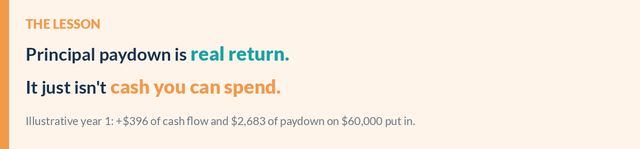
Principal paydown is real return. It just isn't cash you can spend.
ONE STEP THIS YEAR
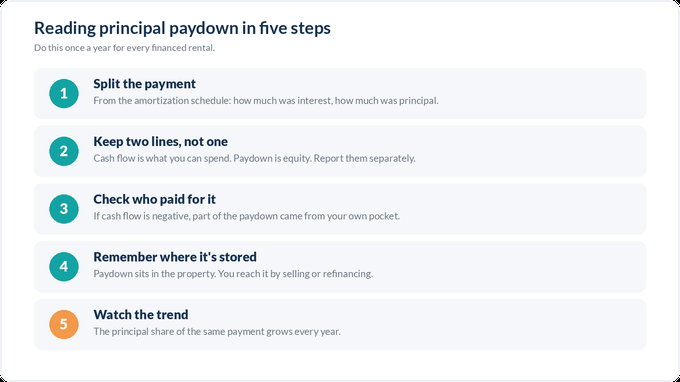
For every financed rental, once a year:
- Split the payment using the amortization schedule: interest paid, principal paid.
- Keep two lines, not one: cash flow (spendable) and paydown (equity).
- Check who paid for it: if cash flow was negative, subtract what you added from your own pocket.
- Remember where it's stored: paydown sits in the property until you sell or refinance.
- Watch the trend: the principal share of the same payment grows every year.
FROM ASSET AFC
To see the split on your own loan, Mortgage, Loan & HELOC Amortization is one of our financial tools. It tracks principal and interest payments over the life of a mortgage, supports fixed, variable adjustable and variable static rates, shows the impact of extra monthly prepayments, and summarizes total payments, interest vs principal and the outstanding balance. Find more tools at Asset AFC.
Illustrative numbers only. This isn't investment, tax or legal advice. Rents, costs, rates and loan terms vary, so use your own numbers and check them before you make a decision.
About Asset AFC: practical financial tools for real estate investors and personal finance organization, powerful underneath and simple on the surface.
Comments ()