
A CapEx reserve for rental property is money you set aside every month for the big replacements you already know are coming: the roof, the furnace or AC, the water heater, appliances, flooring. The method is plain arithmetic. For each item, take what it would cost to replace today, divide by the years it has left, and divide by 12. Add the items up, and that's your monthly transfer.
This post walks through that method with one illustrative house, then sorts out the three kinds of "reserve" money that landlords tend to blur together: maintenance, CapEx and the vacancy or emergency fund.
THE PROBLEM
A roof doesn't send a monthly bill. It sends one large bill, years from now, and it rarely tells you the exact month.
That makes it easy to leave out of a deal analysis and easy to leave out of a monthly budget. The rental seems to clear a healthy amount each month, the extra sits in the operating account, and some of it gets spent or drawn out. Then the furnace quits in January, and the money that looked like profit turns out to have been the furnace's money all along.
The usual patch is a flat percentage of rent. It's quick, and it beats zero. But a percentage of rent knows nothing about the building. Two houses with the same rent can have a five-year-old roof and a twenty-two-year-old roof. One percentage can't be right for both.
WHY IT HAPPENS
Three things make CapEx easy to under-fund:
- The costs are lumpy. Operating expenses repeat every month or every year. Capital items show up once a decade or so, and a cost that lands that rarely doesn't feel real until it does.
- Expected life isn't remaining life. The lifespan printed on the box starts on the day the item was installed, not the day you bought the property. If the water heater was put in years before you closed, your runway is shorter than the label suggests. Budgeting from the full lifespan under-saves exactly the items closest to failing.
- One account hides everything. When rent, repairs, reserves and owner draws all share one balance, a healthy-looking number can be mostly money that's already spoken for.
None of these are math problems. They're habit and bookkeeping problems, so the fix is a small system rather than a better guess. Spread out, the same $12,000 roof is $100 a month for ten years.
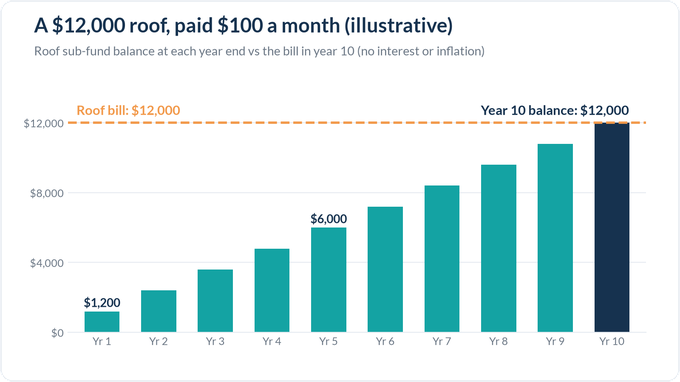
HOW TO FIX IT: Build a CapEx reserve for rental property in five steps
Step 1: List the big components and their age.
Roof, furnace or AC, water heater, appliances, flooring and paint cover most single-family rentals. Add anything specific to your building: windows, a deck, a driveway, an older sewer line. The inspection report, install labels on equipment and permit records help with ages. If you don't know an age, guess on the old side and mark it as a guess.
Step 2: Price a replacement today.
Use a recent quote or what a local contractor would charge, not a national average from a website. Today's price is a fine starting point. For items that are many years out, pricing them a little above today's quote gives you some room for cost increases.
Step 3: Divide by the years left, then by 12.
Annual reserve = replacement cost ÷ remaining years. Monthly transfer = annual reserve ÷ 12.
Illustrative house (example numbers only, not guidance for your property):
Roof: $12,000 ÷ 10 years = $1,200 a year, $100 a month
Furnace / AC: $7,200 ÷ 8 years = $900 a year, $75 a month
Water heater: $1,800 ÷ 3 years = $600 a year, $50 a month
Appliances: $3,000 ÷ 5 years = $600 a year, $50 a month
Flooring & paint: $4,800 ÷ 8 years = $600 a year, $50 a month
Total: $28,800, or $3,900 a year, $325 a month
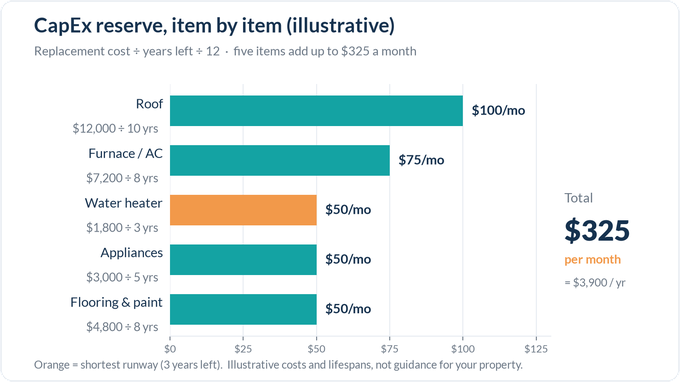
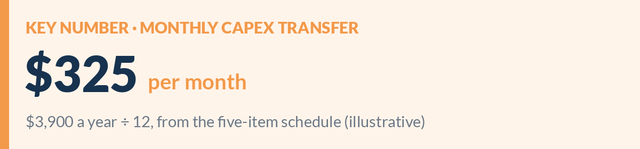
Look at the water heater. It's the cheapest item on the list, but with three years left it needs as much each month as the appliances or the flooring. Short runway, high transfer.
If you already have money set aside for an item, subtract it first. Say $600 is already earmarked for that water heater: ($1,800 − $600) ÷ 36 months is about $33 a month instead of $50.
For comparison, a flat 5% of an illustrative $2,200 rent would be $110 a month, about a third of this schedule. On a newer house, the component number could come out below a percentage. That's the point: the schedule follows the building, not the rent.
Step 4: Keep three buckets separate.
- Maintenance: small, frequent fixes such as a running toilet, a furnace filter or a service call. It's an operating expense, budgeted monthly and paid from the operating account.
- CapEx sinking fund: the scheduled replacements in the schedule above. A separate savings account, one automatic transfer, and a running total per item so you know how much of the balance belongs to the roof.
- Vacancy and emergency fund: what you can't schedule, like an empty month, late rent, an insurance deductible or a furnace that dies years early. Size it in months of the property's fixed costs, including the loan payment, and refill it after you use it.
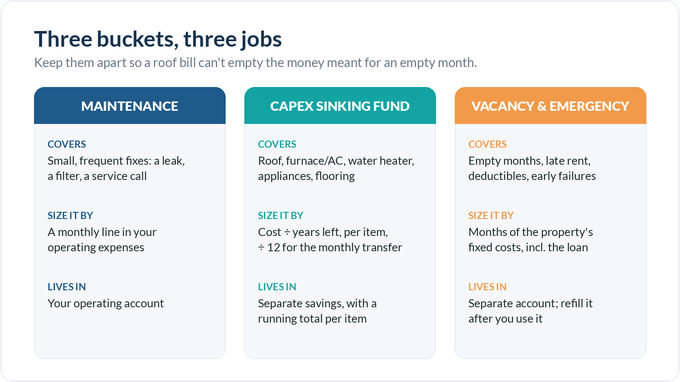
Mixing them is how a roof replacement drains the account that was supposed to carry you through the next vacancy.
Step 5: Re-run it once a year and after every replacement.
Prices move, and items age faster or slower than expected. When something is replaced, its clock resets. If a new water heater is expected to last 12 years (illustrative), its line drops from $50 to $12.50 a month ($1,800 ÷ 144 months). The total is a number you maintain, not one you set once.
The same schedule belongs in your deal analysis before you buy. If a property only cash flows before the $325 comes out, it doesn't really cash flow; it's borrowing from its own roof.
ONE STEP FOR THIS WEEK
Pick one rental. Write down five big items, their rough age and a replacement price. Do the division. Then set a single automatic transfer for the total into a separate savings account, dated for the day after rent usually lands. You can refine the numbers later; the habit matters more than the exact figure.
FROM ASSET AFC
If you're analyzing a property before you buy, Asset AFC's Cashflow Analyzer Pro (one-time purchase) lets you allocate reserve funds for vacancy and repairs, and its net cash flow figure includes them, so the number you judge the deal on already has the roof's share taken out. It's a tool for organizing your own assumptions, not a promise of returns. Do your own research for your market and goals.
About Asset AFC: practical financial tools and analysis tools for real-estate investors and personal-finance organization — powerful underneath, simple on the surface.
From Asset AFC: to run these numbers yourself, try Cashflow Analyzer Pro, one of our real estate tools for rental investors. Explore more real estate tools from Asset AFC.
Tracking actual repair and replacement costs after you buy
Multi-Property Rental Income & Expense Tracker
Use this Excel workbook to record actual rental income and expenses by property, with customizable categories and monthly and annual summaries for up to 50 properties. Separately maintain the reserve schedule and account balance. A transfer into savings is not the same thing as paying for a repair; keep the distinction clear so you can compare planned reserves with actual replacement costs.
Comments ()